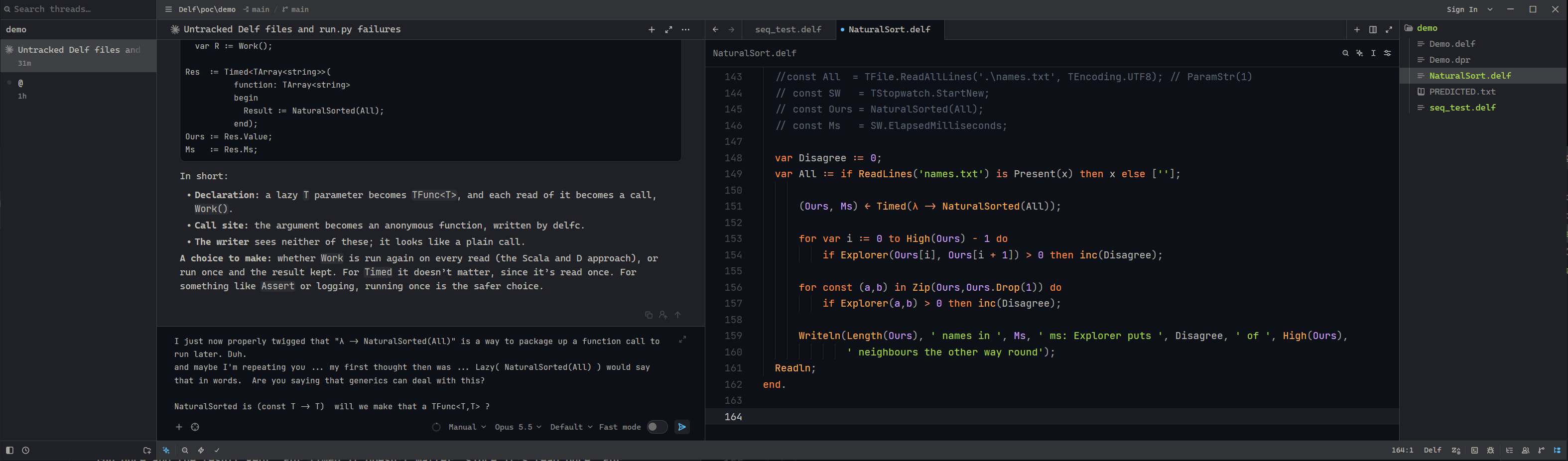
{$APPTYPE CONSOLE}
program GuardPatrolGrid_Using_Optional;

{ Input: the puzzle's published sample (AoC 2024 day 6, part 1).  https://adventofcode.com/2024/day/6

The map shows the current position of the guard with ^ (to indicate the guard is currently facing up from the perspective of the map). Any obstructions - crates, desks, alchemical reactors, etc. - are shown as #.
Guards follow a very strict patrol protocol which involves repeatedly following these steps:
- If there is something directly in front of you, turn right 90 degrees.
- Otherwise, take a step forward.

  Output (Claude, 23 Oct, before compiling):
    start: (4, 6)
    turns: 10
    visited: 41

  No warnings on Win32, Win64  }

uses
  System.SysUtils, System.Types, Demo.OptionalGrids;

const
  Lines: TArray<string> = [
    '....#.....',
    '.........#',
    '..........',
    '..#.......',
    '.......#..',
    '..........',
    '.#..^.....',
    '........#.',
    '#.........',
    '......#...'];

type
  TDir  = (Up, Right, Down, Left);
  TCell = (Open, Wall);

  TStep =
    | Moved (Pos: TPoint)            // rust-style enum with payloads
    | Turned(Facing: TDir)
    | Exited;

function Step(Dir: TDir): TPointDelta;
begin
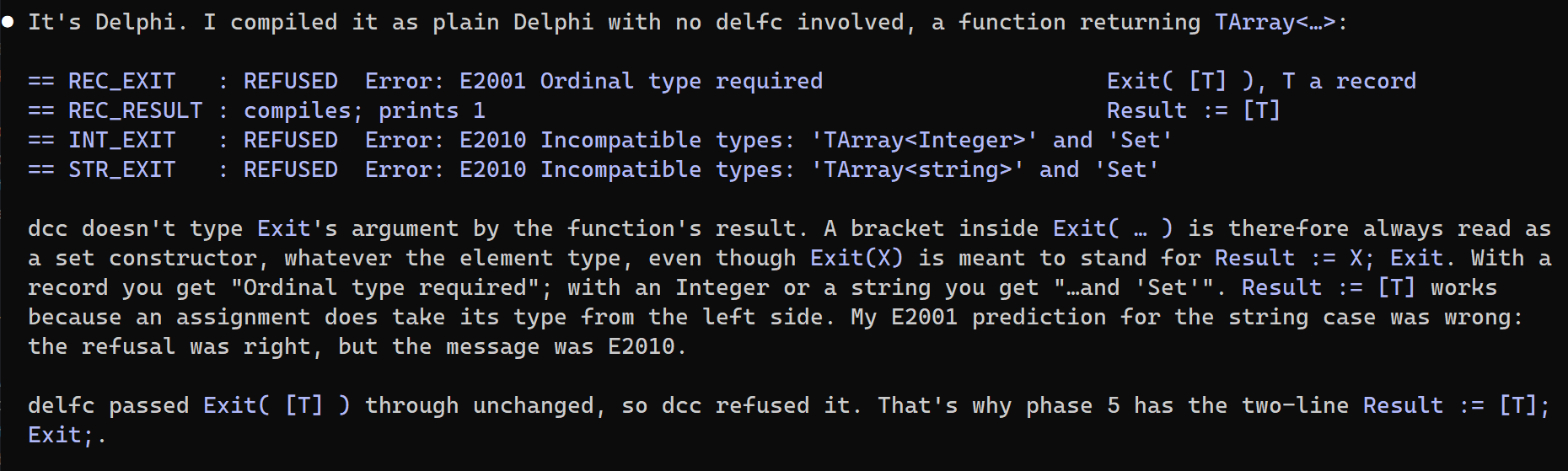
  Exit( match Dir of
          | Up    : (dx: 0; dy: -1)  // spontaneous records
          | Right : (dx: 1; dy:  0)
          | Down  : (dx: 0; dy:  1)
          | Left  : (dx:-1; dy:  0)
        end
      );
end;

function Turn(Dir: TDir): TDir;
begin
  Exit( match Dir of
          | Up    : Right
          | Right : Down
          | Down  : Left
          | Left  : Up
        end
      );
end;

function Start(const Input: TGrid<Char>): Optional<TPoint>;
begin
  for var Row in Input.Rows do
    match Row.Find('^') of
      | Present(x) : Exit( Present(Point(x, Row.Index)) )
      | Absent     : {skip row}
    end;
  Exit( Absent );
end;

function Advance(const Grid:     TGrid<TCell>;
                 const GuardPos: TPoint;
                       Facing:   TDir) : TStep;
begin
  const Next := GuardPos + Step(Facing);
  Exit( match Grid.TryGet(Next) of
          | Present(Wall) : Turned(Turn(Facing))
          | Present(Open) : Moved(Next)
          | Absent        : Exited
        end
      );
end;

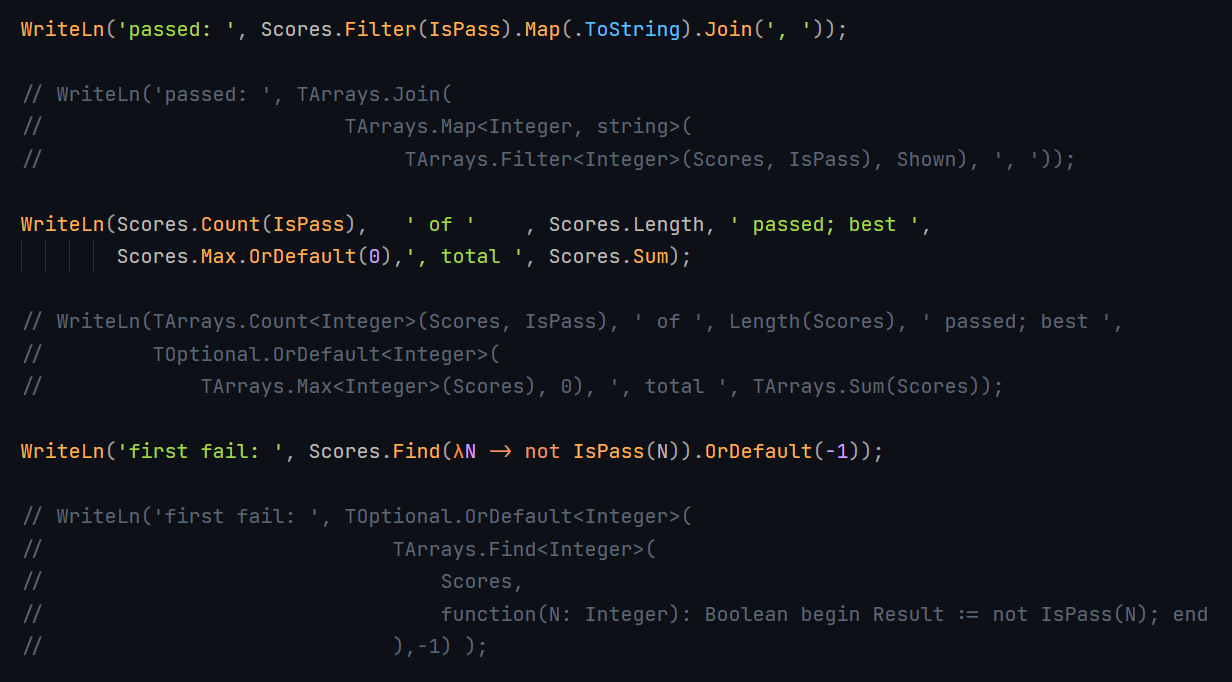
// In Delphi,
//   const CharToCell: TFunc<Char, TCell> =
//     function(Ch: Char): TCell begin
//                                 exit( if Ch = '#' then Wall else Open );
//                               end;
// and λch -> False
//   function(ch: char): Boolean begin exit( False ); end
//

begin
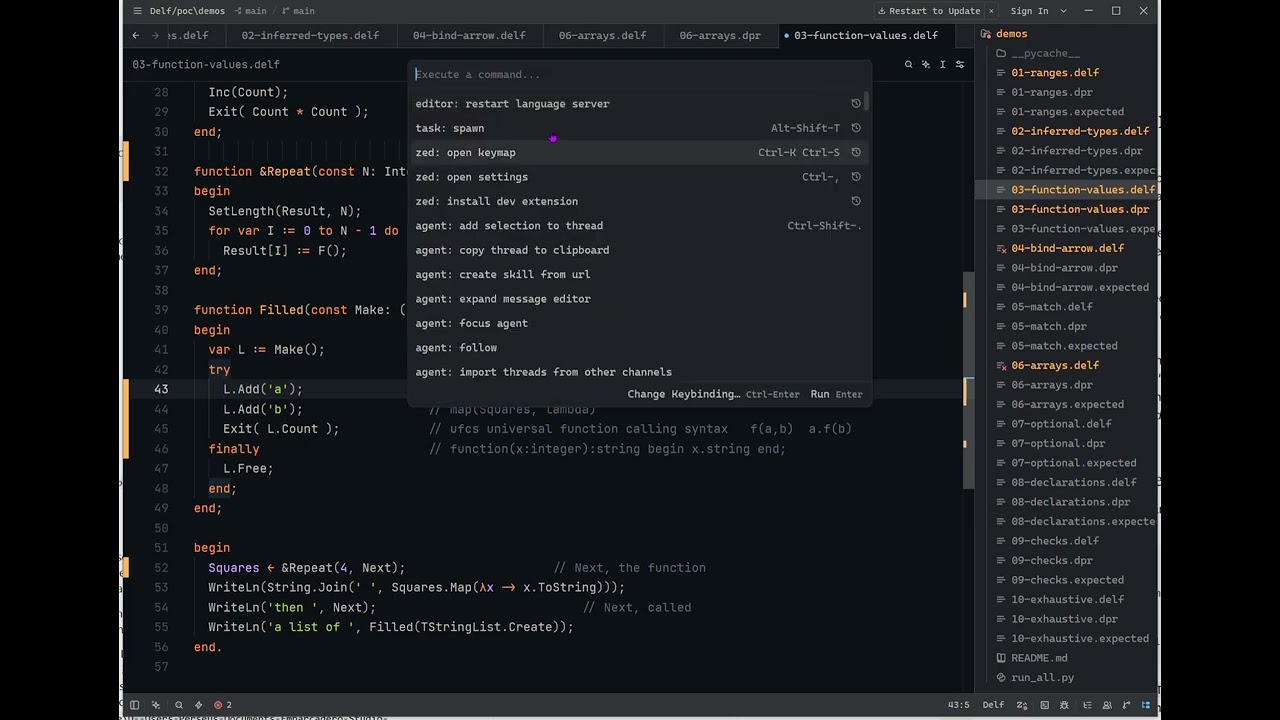
  const FnCharToCell := λ(Ch: Char) -> if Ch = '#' then Wall else Open;
  const Input := TGrid<Char>.Create(Lines, Id);
  const Grid  := Input.Map(FnCharToCell);
  var   Seen  := Input.Map(λch -> False);

  match Start(Input) of
    | Present(Pos) : var GuardPos := Pos
    | Absent       : begin writeln('no start point found'); Exit; end
  end;

  Seen[GuardPos] := True;

  var Facing  := Up;
  var Turns   := 0;
  var Visited := 1;

  writeln('start: ', GuardPos.ToString);

  while True do
  begin
    match Advance(Grid, GuardPos, Facing) of
      | Moved(Pos)  : begin
                        if not Seen[Pos] then begin Inc(Visited);  Seen[Pos] := True; end;
                        GuardPos := Pos;
                      end
      | Turned(Dir) : begin Inc(Turns); Facing := Dir; end
      | Exited      : Break
    end;
  end;

  writeln('turns: ', Turns);
  writeln('visited: ', Visited);
end.
{$APPTYPE CONSOLE}
program Hangman;

{ A small Delf demo for a forum post
 -  match on strings
 -  for … in with Enumeration.
 The guesses are pre-decided, so every run prints the same.

  Output :
    e     _ E _ _ _ _
    hint  a language, and an oracle
    x     no, 4 chances left
    l     _ E L _ _ _
    p     _ E L P _ _
    ?     a language, and an oracle
    z     no, 3 chances left
    d     D E L P _ _
    h     D E L P H _
    i     D E L P H I
    solved, with 3 chances left }

uses
  System.SysUtils;

const
  Word    = 'DELPHI';
  Guesses : TArray<string> = ['e', 'hint', 'x', 'l', 'p', '?', 'z', 'd', 'h', 'i', 'quit'];
  Lives   = 5;

type
  TMatches = TInitArray<Boolean>;


function ToString(const Found: TMatches): string;
begin
  Result := '';
  for var (i, ch) in Word.Enumerate do
    Result := Result + ( if Found[i] then ch else '_' ) + ' ';
end;


function Reveal(Letter: Char; var Found: TMatches): Boolean;
begin
  Result := False;
  for var (i, ch) in Word.Enumerate do
    if ch = Letter then begin Found[i] := True; Result := True; end;
end;


function Solved(const Found: TMatches): Boolean;
begin
  for const b in Found do if not b then Exit( False );
  Exit( True );
end;


begin
  var Found := TMatches.create( Length(Word), False );
  var Left  := Lives;

  for const Guess in Guesses do
  begin
    Write(Guess.PadRight(6));
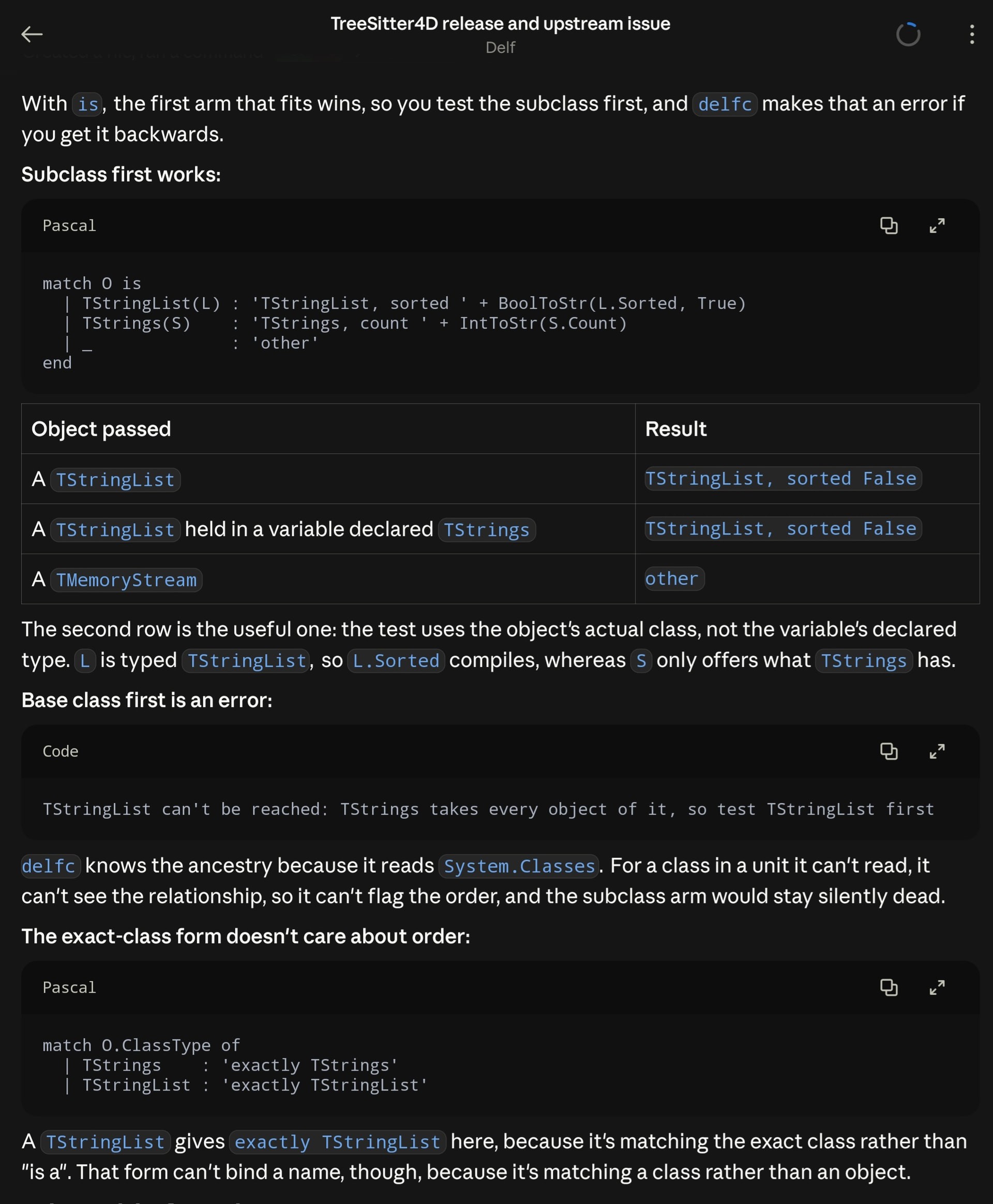
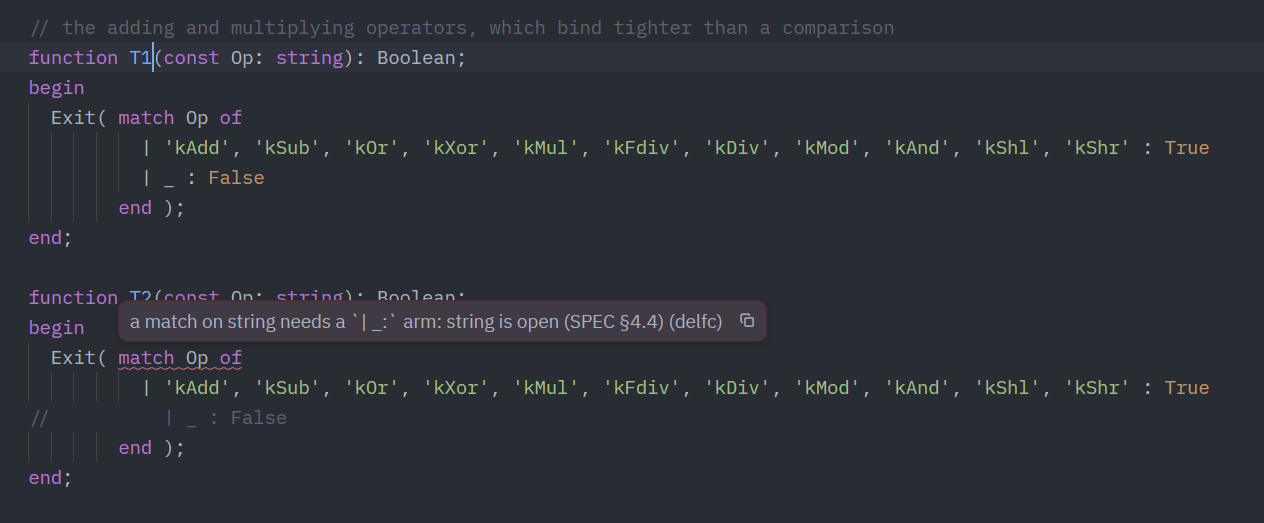
    match Guess.ToUpper of
      | 'HINT', '?' : writeln('a language, and an oracle')
      | 'QUIT'      : begin writeln('bye'); Break; end
      | _           : if Reveal(Guess.ToUpper.Chars[0], Found) then
                         writeln(Found.ToString)
                      else
                         begin Dec(Left); writeln('no, ', Left, ' chances left'); end
    end;

    if Solved(Found) then begin writeln('solved, with ', Left, ' chances left'); Break; end;
    if Left = 0      then begin writeln('hanged'); Break; end;
  end;
end.
Equivalent
function Start(const Input: TGrid<Char>): Optional<TPoint>;
begin
  for var Row in Input.Rows do
    match Row.Find('^') of
      | Present(x) : Exit( Present(Point(x, Row.Index)) )
      | Absent     : {skip}
    end;
  Exit( Absent );
end;
function Start(const Input: TGrid<Char>): Optional<TPoint>;
begin
  for var Row in Input.Rows do
    if Row.Find('^') is Present(x) then Exit( Present(Point(x, Row.Index)) );
  Exit( Absent );
end;
I saw on a Delphi-Praxis post that @davidberneda had a repo with a somewhat similar goal …
(hmmm .. maybe I’ve linked it before on the Forum somewhere  )
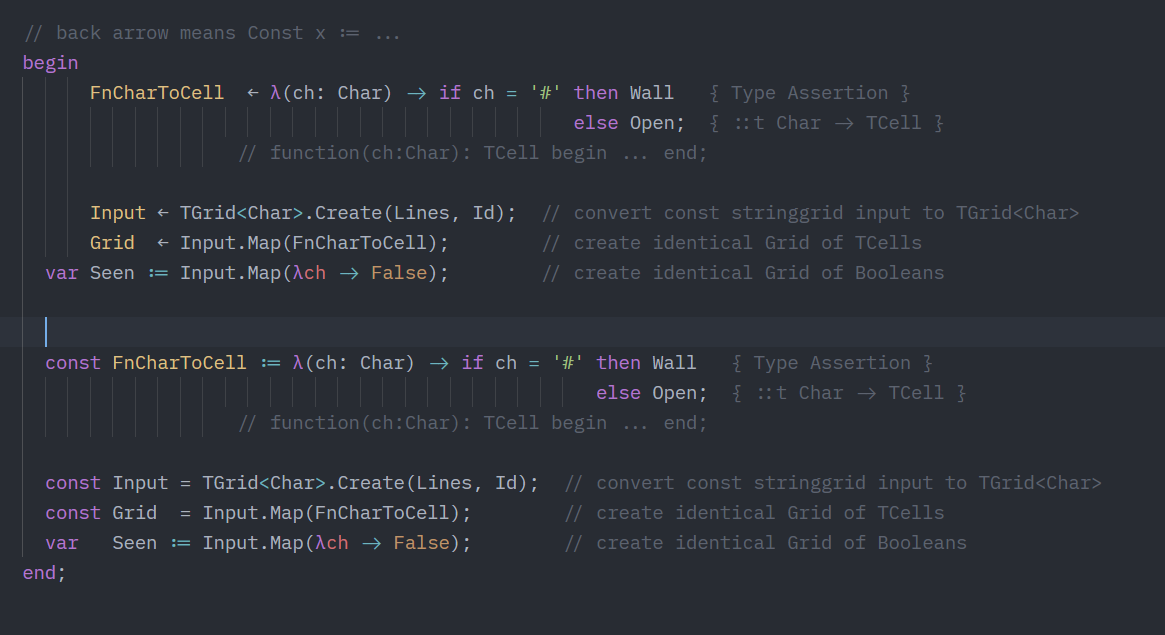
// back arrow means Const x := ...
begin
      FnCharToCell  ← λ(ch: Char) -> if ch = '#' then Wall   { Type Assertion }
                                                 else Open;  { ::t Char -> TCell }
                   // function(ch:Char): TCell begin ... end;

      Input ← TGrid<Char>.Create(Lines, Id);  // convert const stringgrid input to TGrid<Char>
      Grid  ← Input.Map(FnCharToCell);        // create identical Grid of TCells
  var Seen := Input.Map(λch -> False);        // create identical Grid of Booleans
end;
// 'normal'
begin
  const FnCharToCell := λ(ch: Char) -> if ch = '#' then Wall   { Type Assertion }
                                                   else Open;  { ::t Char -> TCell }
                   // function(ch:Char): TCell begin ... end;

  const Input = TGrid<Char>.Create(Lines, Id);  // convert const stringgrid input to TGrid<Char>
  const Grid  = Input.Map(FnCharToCell);        // create identical Grid of TCells
  var   Seen := Input.Map(λch -> False);        // create identical Grid of Booleans
end;