It turns out that this topic seems to be a strong discriminator on Local LLMs, operating without outside search access.
I’m halfway down this list, and only Gemma4:31b has returned a good answer. Nearly twice, actually (first time with internet).
codellama:13b                       7.4 GB
deepcoder:14b                       9.0 GB
deepseek-coder-v2:latest            8.9 GB
deepseek-coder:33b                   18 GB
deepseek-coder:6.7b                 3.8 GB
deepseek-r1:8b                      5.2 GB
gemma3:12b                          8.1 GB
gemma4:12b                          7.6 GB
gemma4:26b                           17 GB
gemma4:31b  ****                     19 GB
gemma4:e4b                          9.6 GB

llama3.1:8b                         4.9 GB
mistral-nemo:latest                 7.1 GB
qwen2.5-coder:14b                   9.0 GB
qwen3-coder:30b                      18 GB
qwen3.5:9b                          6.6 GB
qwen3.6:latest                       23 GB
qwen3.8:27b                          17 GB
qwen3:30b                            18 GB
qwen3:4B-Instruct-2507-q4_k_m       2.5 GB
qwen3:4b                            2.5 GB
qwen3:8b                            5.2 GB
How is an interface delegated to a property in delphi? (it uses the implements keyword)
Thought for 329.7 seconds
In Delphi, when you use the implements keyword on a property (or a field), you are telling the compiler: “Whenever someone calls a method of this interface on this class, don’t look for the code here; instead, redirect the call to the object held by this property.”
This is a powerful design pattern that allows you to compose objects rather than relying solely on deep inheritance.
Here is the detailed breakdown of how it works and a complete code example.
The Conceptual Workflow
- The Interface: Defines the contract.
- The Implementation Class: A class that actually contains the logic for those interface methods.
- The Host Class: A class that “claims” to implement the interface, but instead delegates the work to an internal instance of the Implementation Class via a property.
Complete Code Example
unit InterfaceDelegationDemo;

interface

type
  { 1. The Interface }
  IWorker = interface
    ['{A1B2C3D4-E5F6-4A5B-8C9D-0E1F2A3B4C5D}']
    procedure DoWork;
  end;

  { 2. The Implementation Class }
  // This class actually does the work.
  TWorkerImpl = class(TInterfacedObject, IWorker)
  public
    procedure DoWork;
  end;

  { 3. The Host Class }
  // This class delegates the IWorker interface to the 'Worker' property.
  TCompany = class(TInterfacedObject, IWorker)
  private
    FWorker: IWorker;
  public
    { The magic happens here }
    property Worker: IWorker read FWorker write FWorker implements IWorker;
  end;

implementation

{ TWorkerImpl }
procedure TWorkerImpl.DoWork;
begin
  Writeln('The worker is doing the actual labor!');
end;

end.
How to use it in code:
var
  MyCompany: TCompany;
  MyWorker: TWorkerImpl;
begin
  MyCompany := TCompany.Create;
  MyWorker := TWorkerImpl.Create;

  // Assign the implementation to the property
  MyCompany.Worker := MyWorker;

  // We call DoWork on the COMPANY, but the WORKER executes it.
  // Because of 'implements IWorker', TCompany behaves as if it is an IWorker.
  MyCompany.DoWork;
end;
What is happening under the hood?
When you add implements IWorker to the property, the Delphi compiler automatically generates a “stub” or “wrapper” method in the TCompany class’s Virtual Method Table (VMT).
Instead of you having to write this:
procedure TCompany.DoWork;
begin
  FWorker.DoWork; // Manual delegation
end;
The compiler generates that logic for you in the background.
Key Technical Rules
- Type Match: The property must be of the same interface type (or a descendant) as the interface being implemented. You cannot use
implements IWorkeron a property of typeTWorkerImpl(the class); it must be of typeIWorker(the interface). - Reference Counting: Because the property is an interface, Delphi’s automatic reference counting takes over. When you assign
MyCompany.Worker := MyWorker, the reference count of the worker object increases. - Overriding: If you decide later that
TCompanyneeds to do something extra before the worker does the job, you can simply declare the methodDoWorkexplicitly inTCompany. The explicit method will take precedence over the delegated property. - Fields vs. Properties: You can also use
implementson a private field:FWorker: IWorker implements IWorker;The result is the same, but using a property allows you to change the implementation object at runtime from outside the class.
[EDIT : I dunno atm if #4 is true ??? ]
When should you use this?
- Composition over Inheritance: When you want a class to have the functionality of another class without inheriting from it.
- Reducing Boilerplate: When an interface has 20 methods, and you don’t want to write 20 “pass-through” methods that just call an internal object.
- Dynamic Behavior: You can swap the implementation object at runtime. For example, you could switch
MyCompany.Workerfrom aTHumanWorkerto aTRobotWorker, and the rest of your code (which treats the company as anIWorker) never needs to change.
we can combine these :
MyWorker := TWorkerImpl.Create;
MyCompany.Worker := MyWorker;
Thought for 293.8 seconds
Yes, you absolutely can combine them into a single line.
MyCompany.Worker := TWorkerImpl.Create;
While this looks like a simple shortcut, there is some very important “magic” happening here regarding Memory Management and Reference Counting that you should be aware of.
1. The Implicit Cast
When you call TWorkerImpl.Create, it returns an instance of the class (TWorkerImpl). However, the Worker property is defined as the interface (IWorker).
Delphi performs an implicit cast. Because TWorkerImpl implements IWorker, the compiler automatically converts the class instance into an interface pointer.
2. Automatic Lifetime Management (The “Magic”)
This is the biggest advantage of this approach. Because TWorkerImpl inherits from TInterfacedObject, it uses Reference Counting.
- Creation: When
TWorkerImpl.Createis called, the object is born. - Assignment: The moment you assign it to
MyCompany.Worker, the reference count of the worker object increments to 1. - Ownership:
TCompanynow effectively “owns” the worker. You do not need to keep a separate variable to track the worker, and you must not call.Freeon it manually. - Destruction: When
TCompanyis destroyed, or if you assignniltoMyCompany.Worker, the reference count drops to 0, and theTWorkerImplobject is automatically destroyed by the system.
Comparison: Manual vs. Interface Delegation
The “Old School” Way (Manual Memory Management): If you weren’t using interfaces, you would have to do this:
MyCompany.Worker := TWorkerImpl.Create;
try
  // use it
finally
  MyCompany.Worker.Free; // Manual cleanup required
end;
The Interface Delegation Way:
MyCompany.Worker := TWorkerImpl.Create;
// No 'try...finally' needed for the worker!
// It will clean itself up when the Company is gone or the property is cleared.
One Critical Warning 
For the combined line MyCompany.Worker := TWorkerImpl.Create; to work safely, the implementation class must inherit from TInterfacedObject (or implement IInterface manually).
If TWorkerImpl inherited from TObject instead of TInterfacedObject, the code would compile, but you would have a memory leak because there would be no reference counting mechanism to trigger the destruction of the object.
 Basic Syntax
 How It Works Under the Hood
 Key Rules & Best Practices
 Delegation vs Manual Forwarding
 ]]
]]

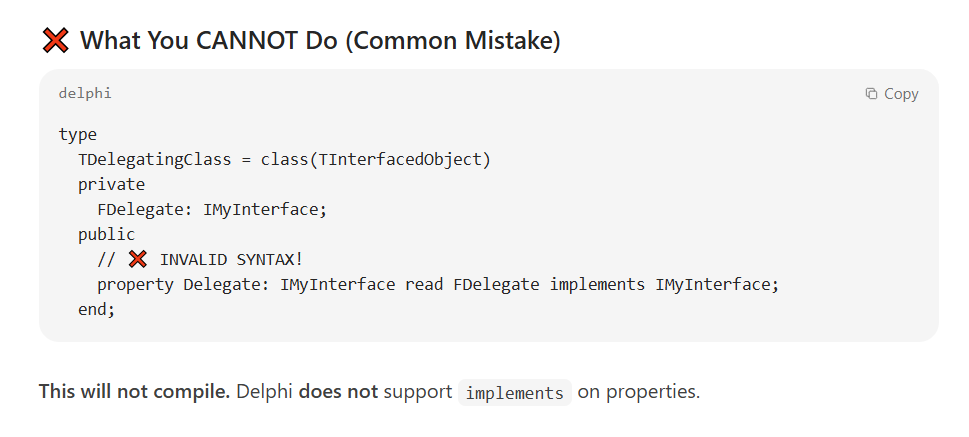
 Would be a compile error